Objects Layer
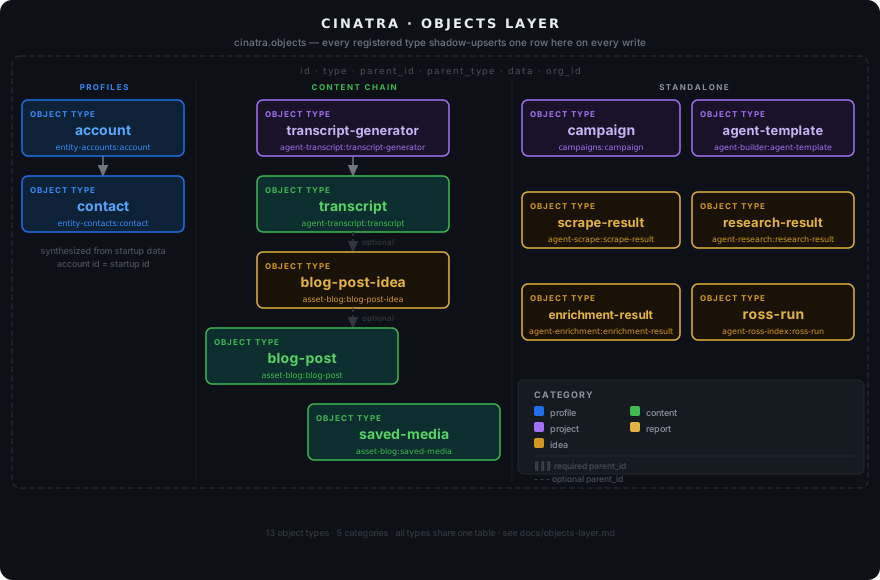
The objects layer is a unified JSONB shadow table (cinatra.objects) that provides a single queryable surface over every persistent object in Cinatra — regardless of which package stores it or what storage strategy that package uses internally.
Why it exists
Section titled “Why it exists”Cinatra packages own their own persistence: blob-keyed metadata, row-per-entity tables, or relational tables. This works well for per-package operations but makes cross-package queries (e.g. “show all objects created by this user”, “find everything related to this campaign”) expensive without a shared index.
cinatra.objects solves this with a fire-and-forget shadow write on every mutation. The primary store remains authoritative; the objects table is derived state that is always within one write of being current.
Table schema
Section titled “Table schema”CREATE TABLE cinatra.objects ( -- Base columns id text PRIMARY KEY, type text NOT NULL, -- namespaced type id (@scope/pkg:local) parent_id text, -- self-FK; denormalised parent_type below parent_type text, data jsonb NOT NULL, -- full object payload created_at timestamptz NOT NULL DEFAULT now(), updated_at timestamptz NOT NULL DEFAULT now(), created_by text, -- better-auth user id org_id text, -- organisation scope
-- Provenance and lifecycle source text, -- where the row came from (manual UI, agent run, import, …) agent_id text, -- agent that produced this row, when applicable run_id text, -- specific run id, for agent-produced rows deleted_at timestamptz, -- soft-delete; rows with deleted_at IS NOT NULL are tombstoned classification_confidence real, -- LLM classification confidence (0..1) when type was inferred
-- Versioning and packaging package_version text, -- package version that produced this row agent_spec_version text, -- OAS spec version active at write time canonical_keys text[], -- per-type canonical identity keys (used for dedupe / upsert) external_id text, -- foreign-system identity, if any
-- Derived index sync state graphiti_sync_status text NOT NULL DEFAULT 'synced', -- 'synced' | 'pending' | 'failed' exported_to jsonb NOT NULL DEFAULT '{}' -- per-channel export receipts);ON CONFLICT (id) DO UPDATE is used on every write, so all mutations are idempotent upserts and the table can be backfilled or re-backfilled at any time without producing duplicates.
Object categories and types
Section titled “Object categories and types”Every registered type belongs to one of five categories. All type IDs are namespaced as @cinatra-ai/<package>:<local-id>:
| Category | Types | Notes |
|---|---|---|
| profile | @cinatra-ai/entity-accounts:account, @cinatra-ai/entity-contacts:contact |
Thin pointer rows for CRM identity records. Canonical records live in Twenty CRM and are reached via the crm_* MCP facade; cinatra holds only the pointer needed for substrate scoping and Graphiti projection. |
| project | @cinatra-ai/assets:blog-project, @cinatra-ai/campaigns:campaign, @cinatra-ai/campaigns:context, @cinatra-ai/agent-builder:agent-template, @cinatra-ai/lists:list |
Long-lived containers that group child objects (a blog pipeline project, a campaign, a list of recipients, a saved agent template). The lists:list schema is registered by the CRM connector. |
| idea | @cinatra-ai/assets:blog-idea |
Intermediate creative stage produced by the blog agent. |
| content | @cinatra-ai/assets:blog-post |
Published or publishable outputs. |
| report | @cinatra-ai/campaigns:recipients, @cinatra-ai/objects:object |
Agent-produced outputs; objects:object is the fallback type for anything not registered to a more specific one. |
Extensions can register their own object types at startup (see objectTypeRegistry.register in @cinatra-ai/objects). The list above describes the first-party types that ship with the platform; an instance with additional installed extensions will see more.
Parent-child hierarchy
Section titled “Parent-child hierarchy”account └── contact
blog-post-idea (idea) └── blog-post (content, optional parent)
saved-media (content, no parent)campaign (project, no parent)campaigns:context (project, no parent)agent-template (project, no parent)list (project, no parent)campaigns:recipients (report, no parent in objects)parent_id / parent_type are nullable. Objects without a registered parent (reports, top-level projects) store NULL.
Dual-write hooks
Section titled “Dual-write hooks”Every package that owns a registered type calls shadowUpsertObject() from src/lib/objects-dual-write.ts on every mutating store operation:
import "server-only";import { upsertObject, type UpsertObjectInput } from "@/lib/objects-store";
export function shadowUpsertObject(input: UpsertObjectInput): void {  try {    upsertObject(input);       // fire-and-forget — not awaited  } catch (error) {    console.error(      `[objects:shadow-write] type=${input.type} id=${input.id ?? "(auto)"} failed:`,      error,    );  }}
Key properties:
- Never throws — a failed shadow write is logged and swallowed; the primary store write is unaffected.
- Fire-and-forget —
upsertObjectis not awaited; latency impact on the calling operation is negligible. - Idempotent —
ON CONFLICT (id) DO UPDATE SET type = EXCLUDED.type, data = EXCLUDED.data, ...so any operation is safe to replay. - Type updates on conflict —
typeis included in the update clause, so an id that transitions between types (e.g. startup → account) is correctly re-typed on the next write.
Hook sites
Section titled “Hook sites”| Store file | Types written |
|---|---|
@cinatra-ai/crm-connector/src/integration/register-object-types.ts |
@cinatra-ai/entity-accounts:account, @cinatra-ai/entity-contacts:contact, @cinatra-ai/lists:list (the three CRM pointer types — formerly split across three deprecation-stub packages, now consolidated) |
src/lib/blog/integration/register-object-types.ts |
@cinatra-ai/assets:blog-project, @cinatra-ai/assets:blog-idea, @cinatra-ai/assets:blog-post |
packages/agents/src/integration/register-object-types.ts |
@cinatra-ai/agent-builder:agent-template |
packages/objects/src/integration/register-types.ts |
@cinatra-ai/objects:object, @cinatra-ai/campaigns:campaign, @cinatra-ai/campaigns:context, @cinatra-ai/campaigns:recipients |
Outputs that agent runs produce — contact discovery batches, generated content drafts, miscellaneous run artifacts — flow through these registered types, typically attached to a @cinatra-ai/lists:list or written as a generic @cinatra-ai/objects:object, rather than each agent registering its own bespoke result type. Per-run provenance (the agent id and run id that produced the row) is stamped on the object via the AsyncLocalStorage-based propagation set up at run start.
Backfill
Section titled “Backfill”One-shot backfill scripts populate the table from existing primary-store data. Safe to re-run on any database at any time.
pnpm backfill:objects # all directly-stored first-party typespnpm backfill:objects:entities # synthesized contacts + accountspnpm verify:objects-counts # side-by-side count comparisonType registration
Section titled “Type registration”Each package registers its object types with objectTypeRegistry from @cinatra-ai/objects at startup. The registry holds the Zod schema, category, lifecycle rules, renderers, and relation declarations for each type.
import { objectTypeRegistry } from "@cinatra-ai/objects";
objectTypeRegistry.register({  type: "@cinatra-ai/assets:blog-post",  category: "content",  schema: blogPostSchema,  lifecycle: { sources: ["agent", "user"], mutableBy: ["agent", "user"] },  renderers: { listRow: BlogPostListRow, card: BlogPostCard, detail: BlogPostDetail },});
Type IDs use the @scope/package:local-id namespace format enforced by OBJECT_TYPE_NAMESPACE_RE.
Renderer boundary — moving off host-side registration. Historically the host owned every type’s view: the
renderersabove were registered host-side and core carried per-type UI knowledge. That inverts the intended boundary — core owns dispatch, the shell, and the never-blank floor; an artifact extension ships its own type’s view. For artifact types, thedetail/previewview ships from the type’s own extension through thecinatra.artifact.uiblock and resolves through the generated renderer map (src/lib/generated/artifact-renderers.ts) plus org-scoped arbitration registries (src/app/artifacts/[id]/renderer-resolution.ts) — not a host-siderenderersregistration keyed by a concrete type id. ThelistRowslot is part of the activecinatra.artifact.uiv1 slot enum alongsidedetailandpreview(ARTIFACT_UI_SLOTSinpackages/sdk-extensions/src/artifact-contract.ts): an extension may ship the compact row renderer the artifacts library resolves for a row it claims.cardandinlineare reserved (ARTIFACT_UI_RESERVED_SLOTS) and are rejected by the closed v1 enum, so acardview stays host-owned through the object-typerenderersblock above. Core treats type identity as opaque: a CI boundary gate (scripts/audit/artifact-ui-boundary-gate.mjs) fails production-core code that depends on, compares, looks up, imports, or transforms by a concrete extension-owned presentation identity for type-specific presentation, against a shrink-only baseline that enumerates every remaining keyed arm with its disposition. Treat the host-siderenderersblock above as the transitional shape for types that have not migrated, not the end-state contract.
Querying the objects table
Section titled “Querying the objects table”From server components
Section titled “From server components”Use readAllObjects() from src/lib/objects-store.ts to query across all or a filtered subset of types. Pair it with registerAllObjectTypes() from src/lib/register-all-object-types.ts to ensure the registry is populated before resolving renderers.
import { readAllObjects } from "@/lib/objects-store";import { registerAllObjectTypes, ASSET_TYPE_IDS } from "@/lib/register-all-object-types";import { objectTypeRegistry } from "@cinatra-ai/objects";import { hasReactRenderers } from "@cinatra-ai/objects/renderer-types";
// Ensure all registered types are loaded (idempotent)registerAllObjectTypes();
// Fetch — optionally filter by type IDsconst objects = readAllObjects({ typeIds: Array.from(ASSET_TYPE_IDS) });
// Render via each type's listRow rendererobjects.map((obj) => {  const def = objectTypeRegistry.resolve(obj.type);  if (!def || !hasReactRenderers(def)) return null;  const ListRow = def.renderers.listRow;  return <ListRow value={obj.data as Record<string, unknown>} />;});
readAllObjects is limited to 200 rows per call. Use the typeIds filter to stay within relevant scope.
Family helper sets
Section titled “Family helper sets”src/lib/register-all-object-types.ts exports two pre-built sets for filtering by UI family:
| Export | Contents |
|---|---|
ASSET_TYPE_IDS |
The set of asset-family type IDs used for ?family=assets filtering (blog projects, blog ideas, blog posts) |
ENTITY_TYPE_IDS |
The set of registered entity-family type IDs used for ?family=entities filtering (contacts, accounts) |
OBJECT_TYPE_NEW_URLS |
Creation route per type (used by /objects/new chooser) |
The unified workspace surface lives in the sidebar’s Information → Data group.
/data— unified list page showing all objects across registered types, filterable by?family=assets,?family=entities, or?type=<typeId>. Each row is rendered via the type’s registeredlistRowrenderer./data/types— type chooser browse view./assetsand similar family-scoped routes remain reachable as typed entry points; they read from the same underlyingobjectstable and surface only their family. CRM rows (account / contact / list) have no cinatra-side browse — agents and humans interact with them through thecrm_*MCP facade (Twenty is the source of truth)./data?family=...— primary objects browser (workspace-scoped). The former cross-org diagnostics view has been retired; type-registry inspection happens through the live data browser and MCPobjects_*primitives.
All sub-routes (detail, edit, new) under typed paths are unchanged — they read and write through the same Objects layer.
Related
Section titled “Related”- Architecture — full platform architecture
src/lib/objects-store.ts—upsertObject,readAllObjects,readObjectsByType,ObjectRecordsrc/lib/objects-dual-write.ts—shadowUpsertObjecthelpersrc/lib/register-all-object-types.ts—registerAllObjectTypes, family sets, creation URL mappackages/objects/src/— registry, type definitions, category taxonomy
Docs content licensed under CC-BY-4.0; embedded code snippets under Apache-2.0.